
Driverless vehicles, as the name suggests, are vehicles that can make decisions on their own instead of relying on a human. In simple terms, an autonomous vehicle is a car manoeuvring on city roads and highways with no physical control from a human driver. There are agreed standard levels of self-driving, which I’ll explain in a straightforward way. No technical knowledge is needed at this stage.
The idea sounds almost unrealistic and raises a lot of questions. So let’s dive deeper. How does this technology actually work? What are the levels of automated driving? And what are the building blocks of an AV?
Levels of autonomous driving
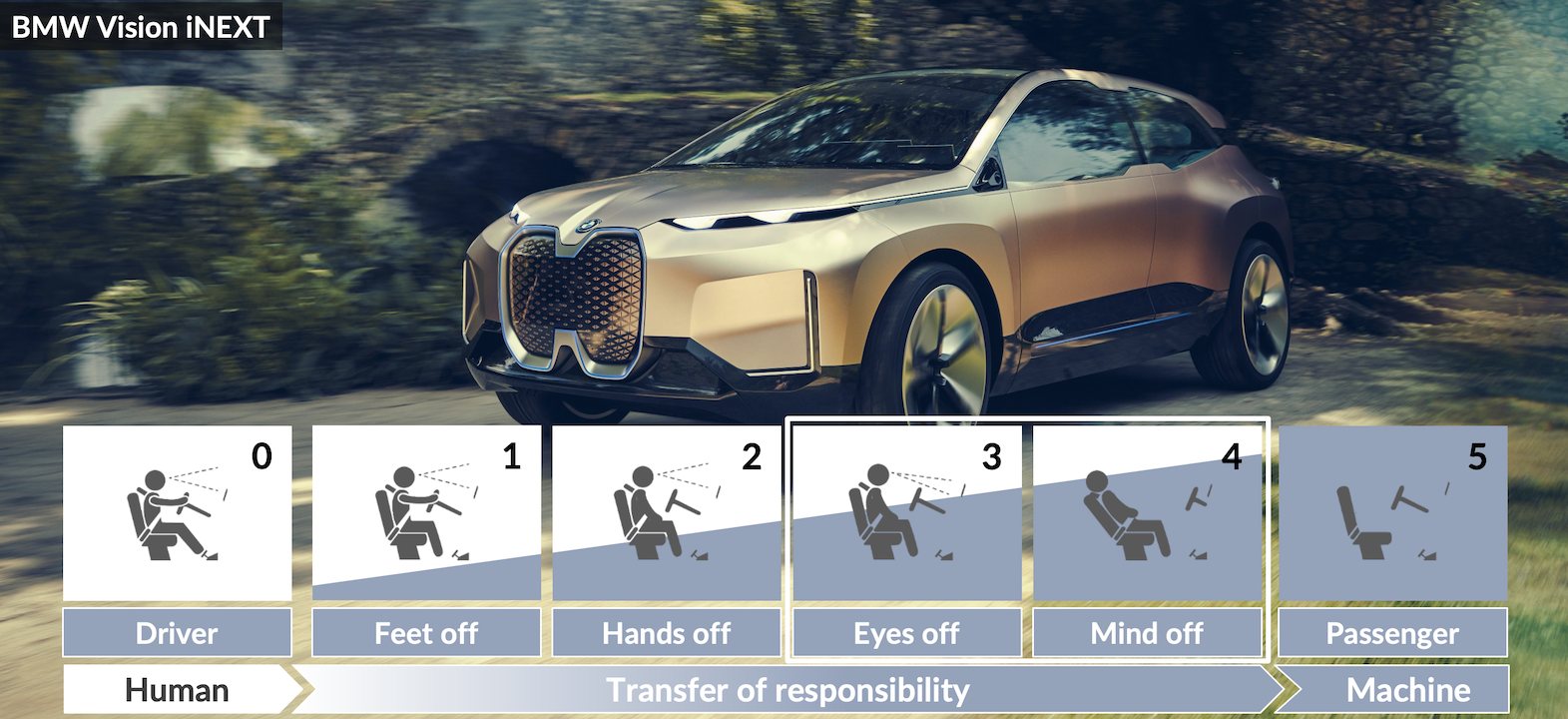 A pictorial representation of the levels of driving automation, from the LeSS Huge case studies.
- Level 0: the driver fully controls the vehicle: steering, braking and accelerating.
- Level 1: the vehicle has driver-assistance systems that can perform one task at a time, such as accelerating or braking. Examples include adaptive cruise control and lane centring.
- Level 2: the advanced driver-assistance system (ADAS) controls braking, acceleration and steering in particular scenarios. The driver must still pay attention to the environment throughout the journey.
- Level 3: conditional driving automation. The vehicle performs most tasks on its own; Mercedes-Benz Drive Pilot, for example, can detect other cars and its surroundings and navigate by itself. These vehicles carry cameras, LiDARs and radars for detection and navigation. The driver must still watch the road and be ready to take control in an emergency.
- Level 4: high driving automation. The car does not require any human involvement.
- Level 5: full driving automation. These vehicles drive themselves and can be deployed in the real world for many tasks: autonomous shuttles carrying people, delivery vehicles, or delivery robots taking products to their destination.
Building blocks of an AV
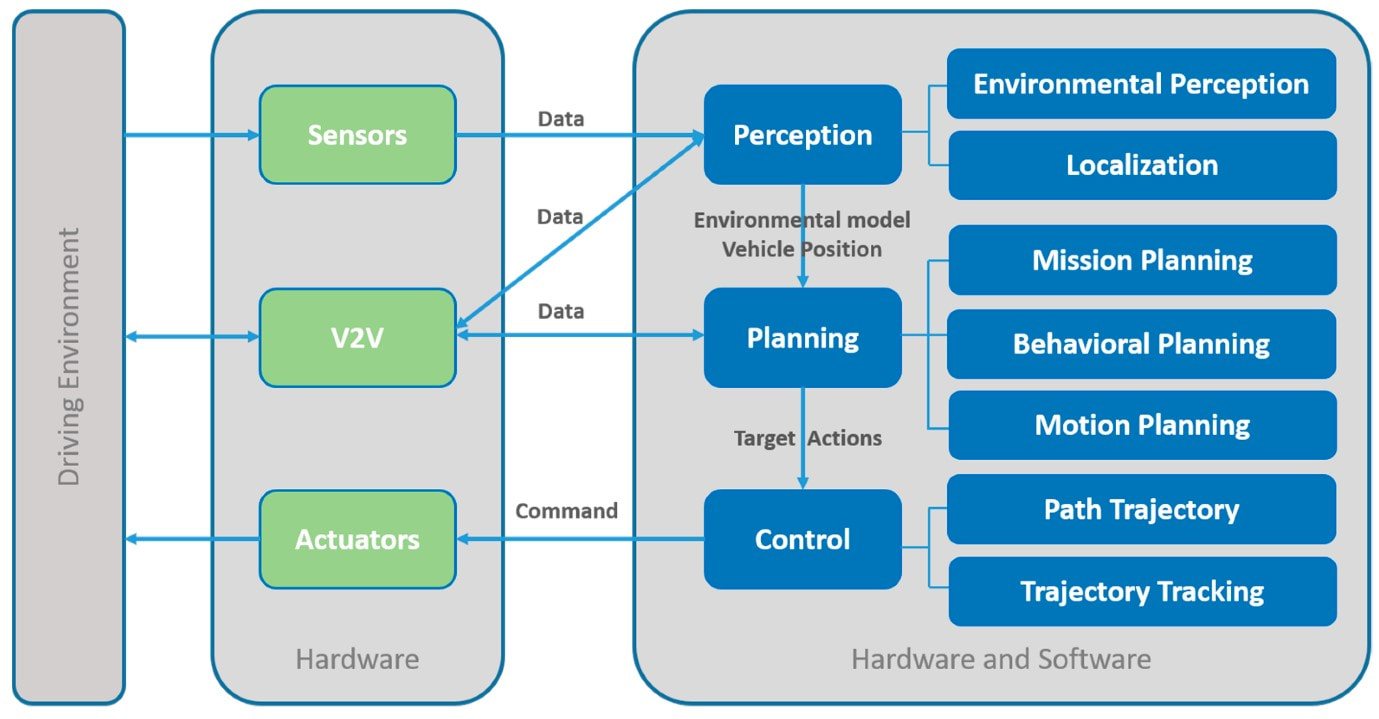 The full working architecture of an AV.
Just as the human brain sees, adapts, plans and reacts to its surroundings, self-driving technology relies on a complex architecture to do the same. It has four modules: perception, localisation, path planning and control. Each of these is a deep subject in itself, so I’ll keep the explanations simple. Here is each one in brief.
- Perception: vision sensors such as stereo cameras, and range sensors such as LiDARs and radars, capture the objects and obstacles in the environment. The data goes to the vehicle software, where machine learning and computer vision algorithms detect objects.
- Localisation: this stage works out where the vehicle is in its environment, along with a map of the surroundings. It is also known as simultaneous localisation and mapping (SLAM), and it uses sensor fusion, combining different sensors for robust results.
- Path planning: this stage takes the data from the previous modules, including information about the surroundings and other road users, and tries to predict, for instance, what a pedestrian is going to do next. Decisions are made from those predictions, which is why it is sometimes called the decision-making stage. Path planning is one of the most essential and complex of the four modules, and it has opened a new area of research for scientists around the world.
- Control: the control module turns the high-level commands from the previous modules into action, such as accelerating, braking or taking over in risky scenarios, depending on the level of automation in the vehicle.
Conclusion
This post is a brief introduction to the concept behind autonomous driving and the architecture at the root of the technology. Later posts cover ongoing research in the automotive and AI sectors.